Modern Acorn Soup
Most people who know me understand that I have a great deal of respect for the Native American and their ability to survive under adverse conditions. They have managed to make use of what they have readily available at hand while wasting nothing in the process. If there were ever one group of natural survivors it would have to be the native tribes of North America.
Take acorns as an example. Acorns are not just for squirrels. The acorn is exceptionally high in protein and contains just about every known essential vitamin known to man. There are many good uses for this readily available nut including soup or grinding it up into a powder for use as fry bread. However, in order to use the acorn you must first know when and how to gather this excellent resource.
We should gather our crop of acorns during the fall season. Discard the first of the acorns that fall from the tree. I don’t suggest this in order to be kind to the squirrels but rather because they are usually wormy and not good for our purpose. You can easily determine acorns which are good from those that are bad by their hunchback look resulting from the enclosed worm larvae.
During my military years I met a Native American friend who related to me how his grandmother would venture out daily in order to find additional acorns for her food storage. He used to jokingly refer to her as his “squirrel grandma”. He claims that she had one room in her home where she saved all her acorns. His largest complaint was that he had to mix up the acorns every week in order to prevent the accumulation of moisture which would encourage mold and destroy the nut.
Once gathered the acorn should season for at least a year in order to ensure that the nuts are dried completely. Next you would crack the hull of the nut open revealing the inner meat. Simply whack the acorn with a mallet or use a pair of pliers to break the hull. As you open the acorn you will notice a red skin which must be removed. My friend hinted at an easy method of accomplishing this task. He explained that by dropping the meat into a pan of water the skin will not only lift right off but it also helps to remove the tannin from the nut.
Inspect the meat for any which might be wormy or dark colored. These should be discarded. Good acorn meat will be clean looking and yellowish in color. Now let the meat soak overnight and in the morning you should drain and rinse the nut. After you have properly drained it put the meat through your meat grinder using a fine blade setting. Place these acorn grindings into a clean cotton muslin bag such as a pillow case or a jelly bag. Next soak the sack in an equal amount of water overnight. In the morning squeeze the water from the sack. Repeat this process over again until such time as you are satisfied with the taste of your acorn meal.
I have been told that to speed up the process you could place your acorn sack in a bowl and simply pour some boiling water over it. Again let it soak for one hour and repeat as necessary. After you have properly leached your acorn flour you should spread it on large cookie sheet and allow it to dehydrate in a 175 degree oven until completely dried.
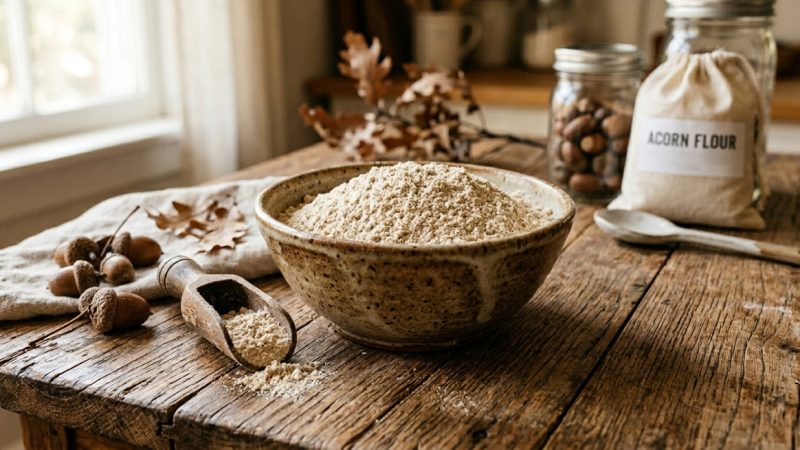
Once you have dried and cleaned the acorn the real task begins. The acorns will now need to be pounded or broken up. You can use a granite mortar and pestle to do this job or you can do it in a much simpler fashion. Either way it is a time consuming process but must be done. To ease your workload a bit you could use a common flour mill. When finished your acorn flour should be similar to wheat flour in consistency.
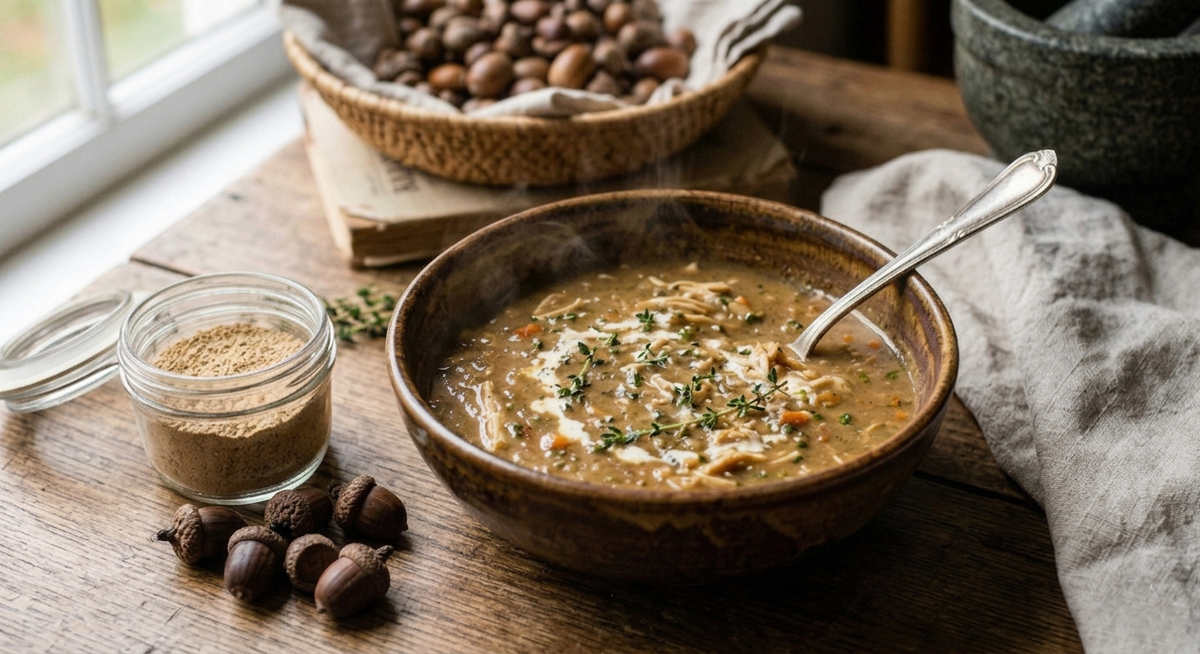
In order to make the soup or mush, stir one cup of flour into two cups of hot, boiling water. I must warn you now you will likely not care for the flavor unless you add some sort of actual meat to it and cook it as you would a normal soup. Several cups of chicken chunks work wonders when combined with a little broth and some seasoning.
As an alternative you can use the acorn meal for any recipe which calls for normal flour such as corn meal muffins etc. Let me know what creative ways you come up with.
The Author:
Joseph Parish – For more information relating to survival visit us at survival-training.info
Photo. Gemini
Source: EA
Editor’s Note:
“What does an acorn taste like?”
If you were to bite into a raw acorn straight off the tree, the primary sensation would be intense bitterness and a “puckering” astringency. This is caused by high concentrations of tannins, which serve as a natural defense mechanism for the oak tree.
However, once acorns have been properly processed (leached of their tannins), their flavor profile changes significantly:
The Flavor Profile
-
Nutty and Earthy: Leached acorns have a mild, deep nuttiness that is often compared to a cross between a chestnut and a sunflower seed.
-
Subtle Sweetness: Depending on the species of oak, there can be a faint, maple-like sweetness, especially in white oak acorns, which are naturally lower in tannins.
-
Neutrality: Because the flavor is relatively subtle, acorn flour often acts as a “canvas,” picking up the flavors of whatever it is cooked with, much like buckwheat or whole wheat.
Texture and Aroma
-
Aroma: When roasted, they give off a warm, toasted scent similar to browned butter or roasted nuts.
-
Texture: Acorns have a high oil and starch content. When ground into meal or flour, they produce a dense, hearty texture that is less “fluffy” than wheat but richer than cornmeal.
Variation by Species
The taste can vary depending on which type of oak tree the acorns come from:
-
White Oaks: Generally considered the “sweetest” and easiest to process because they have fewer tannins.
-
Red/Black Oaks: Much higher in tannins; they require more extensive leaching but often result in a bolder, more robust “woodsy” flavor once cleaned.
The Pioneer View: Waste Not, Want Not
by pioneerthinking.com
If you’d stepped into a drafty cabin on the edge of the Ohio River Valley in the 1840s, you might have found a burlap sack of acorns tucked into a dry corner. To a pioneer family, the acorn wasn’t just a survival curiosity—it was “stretching food.” When the wheat crop failed or the cornmeal bin hit bottom before the spring thaw, the humble oak tree became the family’s silent benefactor.
The Frontier Method
While the modern kitchen benefits from 175-degree ovens and electric grinders, the pioneer version of this process was a true test of grit:
-
Leaching in the Wild: Without the luxury of constant boiling water, many settlers followed the older ways—placing crushed nutmeat in a fine-mesh bag and weighting it down in a clear, running stream. The cold, moving water would slowly carry away the bitter tannins over several days, requiring zero firewood but a great deal of patience.
-
The “Coffee” Substitute: During times of blockade or extreme scarcity, pioneers didn’t just make soup. They would parch the leached acorn pieces until they were dark and brittle, then grind them to brew a “frontier coffee.” It lacked the caffeine kick, but the toasted, nutty aroma provided a much-needed psychological comfort during long winters.
-
Hard-Tack and Johnnycakes: Acorn flour was rarely used alone. It was typically mixed with a bit of precious “boughten” flour or cornmeal to make heavy, dense cakes that could survive a week in a saddlebag.
The Verdict from the Homestead
To the pioneer, the acorn represented the ultimate insurance policy. It was a labor-intensive resource that reminded them that nature provides, provided you’re willing to work for it. They knew what we often forget: that a belly full of “squirrel food” is a sight better than an empty one, especially when seasoned with a bit of salt pork and the satisfaction of a day’s hard labor.
“It’s a long road from the forest floor to the dinner pail, but the oak tree never sends a bill.”