
Pioneer Children and Their Clothing
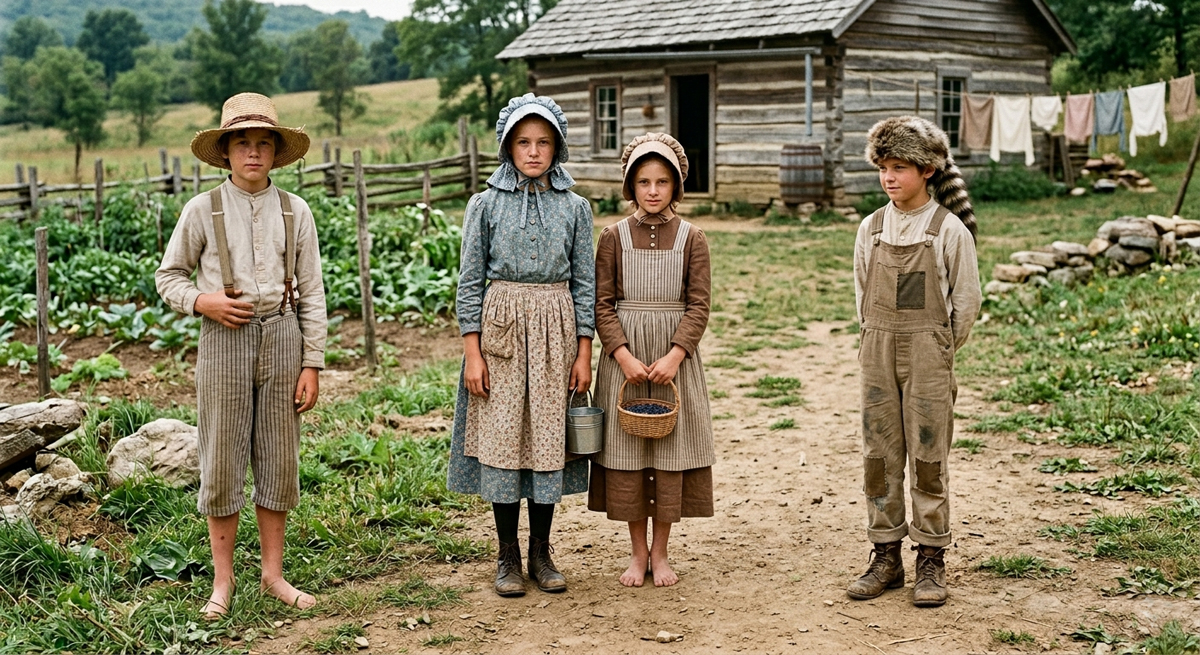
Pioneer children had several types of clothing and various accessories that went with them. They had their sleeping clothes, their work clothes and their formal clothes.
The sleeping clothes usually consisted of a long sleeved night gown and a cap made from cotton or flannel. They were available in several colors and even prints. Sometimes they had little embellishments such as ribbons.
Every day pioneer dresses for little girls were usually ankle length to keep the hems from dragging in the dirt or mud and usually buttoned down the front to the waist line. Little girl’s dresses, just like women’s dresses, all had long sleeves to protect skin from the harsh sun. There were no seasonal fashions like we have today. Long sleeves were worn year round. Little pioneer girls almost always wore slips and pantaloons underneath their dresses and aprons or pinafores and bonnets as outer wear. Every girl, of course, had to wear stockings and pantaloons for modesty and the aprons protected their dresses from getting dirty or torn. Aprons were also useful for carrying heavy loads back and forth from the field to the house. The long brimmed bonnets had a big ruffle in back to protect the neck from the sun and wind. Bonnets almost always matched either the dress or the apron. Sometimes, in the spring and summer, girls would make wreaths of flowers to wear in their hair.
If a girl was lucky enough to have a formal dress, it was usually made of finer cotton or silk and dressed up with ribbons and laces, puff sleeves, gathered tops, and fuller skirts with lacy pantaloons and tiered petticoats underneath. Sometimes, though, the only thing a poorer child might have, to make her every day dress look a little fancier, was a ruffle to add to her collar.
The working clothes of pioneer boys usually consisted of long sleeved cotton shirts, buttoned all the way up to the neck. The shirts were long and full and were usually used as their sleeping clothes. Pants were also loose fitting, button fly, knee length fabrications, also known as knickers, made from cotton, linen or wool. These were worn until the age of 12 or so. If a young boy was from a poor family, he might be forced to wear his father’s cast off long pants. All pants, whether long or short, were usually high waisted and held up by suspenders that crossed in the back rather than with a belt. The pants came in solid colors but stripes or plaids were popular when available. Many boys wore overalls made from the sacks that grain came in because the strength of that fabric made for good working clothes. Around 1850 or so, jeans were invented and were widely distributed due to Levi Straus. Today, jeans are the most popular pant for boys and men and women and girls.
Back in the pioneer days, boys, of course, didn’t wear bonnets like the girls. They wore low crown straw or felt hats with big wide brims and sometimes coonskin caps. Here are some photos of boys in their straw hats and girls with their bonnets and shawls. On Sundays, they’d add a vest and/or coat and a tie that looked more like a scarf than the men’s ties you see today.
→ Dating Old Photographs with Fashion
Back in pioneer times most people had to make their own clothing. There were no department stores or malls like we have now. And there was certainly no online shopping so everyone had no choice but to fend for themselves. They didn’t really mind because, besides hard work in the fields or with the animals or cooking over a roaring fire, there was really nothing much else to do. The men might make boots and shoes or coats from animal hides but all other clothing was made by the women folk. Sewing was the most important skill that a girl could learn and she usually learned it from her mother. It was a mother’s job to do all of the spinning, sewing, knitting and crocheting. Until a girl was old enough to help, most mothers worked their fingers to the bone to make sure their children weren’t running around half naked. It was very rare for a child to get the gift of new clothing. Most items were hand me downs which had been mended over and over again. Strange as it may seem, coats and sweaters were usually luxury items for pioneer girls. To protect themselves from the cold many pioneer girls had to wear 2 dresses together with several slips and petticoats. The lucky girls had shawls or capes to wear in winter.
Not all pioneer children had shoes to wear but the shoes of those who could afford them might have been made from the skins of animals like cows or deer or even buffalo. Socks and other woolen objects might have been made from shearing sheep or goats and spinning their wool into threads and fibers. The finer threads and yarns used for knitting underwear, hosiery and stockings was usually store bought, most likely from a mail order catalog. Yes, they did have mail order catalogs but items ordered didn’t come to the house. They had to be picked up at the general store. Coarse fabrics could be made from flax (linen) and cotton fibers and wool. All of these materials provided an array of different natural earth tone colors but more vibrant rainbow hues could be created from dying cloths with nuts, flowers, berries, leaves and bark.
→ How Pioneers Washed Clothes
If you want to know more about the lives of pioneer children, use the key words, Pioneer Children, at Amazon and write down the book titles that are listed. You can either purchase the books from them or check them out at your local library.
The Author:
Sybrina writes fiction and non-fiction books, articles and songs. Visit her website http://www.sybrina.com.
Photo. Gemini
Source: Ab
The Hardships and Ingenuity of Pioneer Life
by pioneerthinking.com
While clothing was a crucial and labor-intensive part of pioneer life, every aspect of daily existence demanded immense effort and resourcefulness. For these frontier families, self-sufficiency was not a choice but a necessity for survival..
→ “Use It Up, Wear It Out, Make It Do, or Do Without” This famous maxim was a literal way of life for pioneers. They threw absolutely nothing away. Old, worn-out clothing was never discarded; it was repurposed into patches, cut down to fit smaller children, or eventually used to fill quilts, which were both a necessary bed covering and often a rare form of artistic expression for the overworked mothers. Worn-out tools were mended by the father, sometimes using rawhide or wire. “Waste not, want not” applied to every item, every scrap of fabric, and every grain of food, reflecting the deep understanding that everything they owned had been hard-won.
The Hidden Layers of Frontier Fashion
While the outer garments of pioneer children were designed for utility, the construction and maintenance of their entire wardrobe involved fascinating details often overlooked. Clothing wasn’t just about what you could see; it was about survival in a world without climate control.
The Mastery of Material: From Seed to Shirt
Before a needle ever touched fabric, the materials had to be painstakingly produced.
-
Linsey-Woolsey: This was a staple fabric of the frontier—a rugged, coarse material made from a linen warp (longitudinal threads) and a wool weft (transverse threads). It provided the durability of linen with the warmth of wool, making it perfect for winter dresses and trousers.
-
The “Indigo” Goal: While most everyday clothes remained the natural “earth” colors of the fibers, pioneers prized indigo (blue) and madder (red) dyes. Achieving a deep, solid color was a mark of status and skill, as it required multiple dipping processes in smelly, fermented dye vats.
The “Growing” Wardrobe
Because fabric was so expensive and difficult to make, clothing was designed to grow along with the child.
-
Tucks and Hems: Mothers would sew deep “growth tucks” (horizontal folds) into the skirts of dresses. As a girl grew taller, the tuck would be unpicked to let the skirt down, extending the life of the garment by years.
-
The “Hand-Me-Down” Cycle: Clothing was rarely discarded until the fibers literally fell apart. A father’s worn-out trousers would be cut down into a son’s knickers, and a mother’s frayed Sunday dress might be repurposed into several smaller aprons or shirts for the little ones.
Footwear and “Sunday Best”
Shoes were the most difficult item to obtain and were often the most uncomfortable.
Straight-Last Shoes: Until the mid-to-late 1800s, many shoes were made on a “straight last,” meaning there was no difference between the left and right shoe. They were interchangeable until the wearer’s feet eventually broke the leather in.
-
Going Barefoot: To preserve expensive leather, children often went barefoot all spring and summer, saving their shoes only for church or the coldest winter months.
-
Detachable Collars: For formal occasions, a boy might have a single “Sunday” collar that could be buttoned onto his everyday work shirt. This allowed him to look “dressed up” for church without the family having to own a completely separate formal outfit.
Seasonal Adaptations
Without modern insulation, pioneers adjusted their layers to stay alive.
Winter Bulking: In the absence of heavy coats, girls would wear up to four or five petticoats at once to trap body heat. Boys would layer multiple shirts under their wool vests.
-
The “Vermin” Factor: Wool and flannel were warm, but they were also difficult to wash. Clothing often stayed on for days at a time, making lice and skin irritations a common struggle for pioneer children, especially during the winter months when “laundry day” was impossible due to frozen water.
Did You Know? Buttons were a luxury. Many pioneers used “thorn-and-loop” fasteners or simple wooden pegs to keep their clothes closed if they couldn’t afford a set of pewter or bone buttons.



I thought when they turned 6 boys could dress like their fathers.