
Questions and Answers About Wild Turkey?
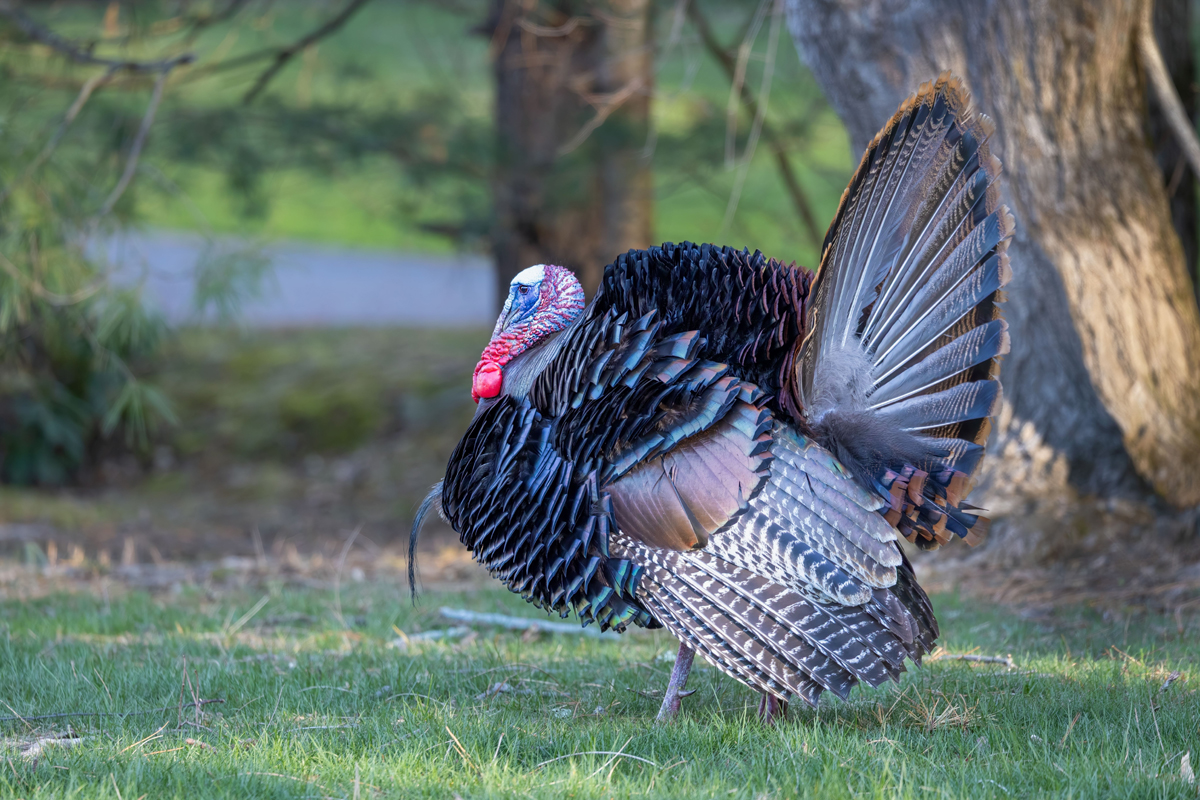
Almost everyone knows that Ben Franklin wanted the Wild Turkey to be our national symbol, rather than the bald eagle. But do you know why? Well, it seems that in those days everywhere you looked there was a wild turkey strutting about. Not only that, but he admired the beautiful mating display when the male’s tail feathers were unfurled in all their glory. Plus, the familiar “gobble, gobble” further endeared the wild turkey to Old Ben.
Nowadays we are more familiar with the domesticated white turkey that we enjoy at Thanksgiving. By the way, why is the domestic turkey white? Many years ago our wild turkey was bred with the Mexican turkey resulting in the color change. There is still evidence of the wild turkey in the dark brown tail tips of the kind we eat today.
Should You Feed Wild Turkeys?
There is a long-standing controversy over whether people should interfere with the natural course of things. However, turkeys forage for food on the forest floor. They scratch at the dirt and overturn leaves and branches. When you have a foot of snow covered by a layer of ice, it’s extremely difficult to do any scratching for food. That is why I am a strong advocate of gathering acorns in the autumn so that I can leave them under my bird feeders for the turkeys when snow is deep. I also scatter sunflower seeds and cracked corn on top of the snow for the wild turkeys. I get a great satisfaction out of helping them to survive the worst winter conditions.
What Else Do Wild Turkeys Eat?
Turkeys are omnivorous. In addition to acorns, they love all other kinds of nuts: hickory nuts, hazel nuts, butternuts, etc. Fruit is another part of their diet, as well as sunflower and other flower and weed seeds, insects and salamanders. We have plenty of salamanders hiding under rocks in our woods, and there‘s no shortage of insects either.
Where Do Turkeys Sleep?
I’ll never forget one morning when I started up into the woods for a walk. All of a sudden I heard all this wing beating and peeping and clucking sounds high in the trees over my head. I had disturbed a flock of wild turkeys that had been roosting in the tall white pines! At sunset turkeys fly up into the trees to roost for the night. They are much safer there than on the ground where foxes, wild dogs, coyotes, etc. find them easy nighttime prey.
How Fast Can They Fly?
These amazing birds can go from zero to 55 mph in a very few seconds. They can also run. Their top running speed is 20 mph! They maintain a good steady walking pace as well. Covering several miles a day is normal for them.
How Many Babies Do They Have?
A female turkey will choose a bush in the woods under which she will lay a clutch of tan and brown speckled eggs from 4 to 17 in number. Mama will indulge her chicks by feeding them, but only for the first few days. She roosts on the ground with her babies, also called ‘poults’, during this time. After that they are on their own and quickly learn to forage for themselves. However, her young will travel with her in a flock all year right through the winter.
We’ve All Seen Tom Turkeys, But What Do the Hens Look Like?
A Hen Turkey’s head has a blue/black color, while the Tom Turkey has a red head with a white spot on the top. Male turkeys are quiet, secretive and elusive most of the time. However when they are trying to secure their harem of hens, they make clucking and peeping sounds, and sometimes a low drumming comes from deep in their throats.
The female is a drab brown/black color and quite thin in the spring. But come autumn all the turkeys take on a much plumper shape. Turkeys have a ‘wattle’, which is a flap of skin under their chin. The other flap of skin that hangs over their beaks is called a ‘snood’. Both can turn bright red when the turkey is agitated or excited.
How Heavy Do Wild Turkeys Become?
Having to make their way in the wild keeps turkeys slimmer than their domestic counterparts. They will weigh from 5 to 19 pounds. Their body measures a hefty 3-½ to almost 4 feet with a wingspan of 4 to almost 5 feet! Domestic turkeys weigh twice as much as wild turkeys and are much too heavy to fly.
How Long Do Turkeys Live?
The average life span of a turkey in the wild is only 3 or 4 years. With all the predators out there and the survival challenges you can see why that is the case.
Also, their territories are shrinking rapidly. Their fondness for hardwood forests that are attached to grassy fields provides them with good food sources, roosting and hiding places. Unfortunately, hardwood forests are being cut down to supply materials for human habitation.
Despite their size, these wonderful birds can take to the air in an explosive burst of speed. They can turn their heads up to 270 degrees, and they have excellent vision and hearing. They can dazzle us with their courtship dances and displays.
I think Old Ben was right. They would have made an excellent national symbol! Gobble, Gobble!
A Pioneer’s View: The Ultimate Forest Companion
by pioneerthinking.com
If you were to step back into the early 1800s and ask a frontier family about the wild turkey, they wouldn’t just praise its beauty—they would tell you it was a cornerstone of survival. To the early pioneer pushing westward into the dense, untamed hardwood forests, the wild turkey was a majestic, clever, and deeply respected neighbor.
“The woods are thick with them, yet they vanish like ghosts the moment a twig snaps.” — Common frontier observation.
For a pioneer family, the wild turkey provided far more than just a hearty meal:
-
The Ultimate Resource: While a single successful hunt could feed a large cabin for days, nothing went to waste. Wealthier homesteaders used the stiff wing feathers to make durable quill pens, while children used them to fletch arrows. The downy feathers were carefully stuffed into mattresses and pillows for warmth during brutal winters.
-
The Frontiersman’s Alarm Clock: Long before the days of cheap clocks, pioneers relied on the heavy “thump-thump” of turkey wings descending from the white pines at dawn. A sudden chorus of alarmed clucks in the brush acted as a natural security system, warning homesteaders of approaching predators or visitors.
-
A Symbol of Forest Abundance: To the pioneer eye, a thriving flock of wild turkeys was the ultimate sign of good land. If the turkeys were fat on acorns and hickory nuts, it meant the soil was rich, the timber was strong, and the homestead would prosper.
While we no longer rely on them for daily survival, looking at a wild turkey through the eyes of a pioneer reminds us of a time when human life and American wilderness were completely intertwined. Old Ben Franklin truly understood the grit and resourcefulness of this bird—traits that matched the very spirit of the people building a new life on the frontier.
The Author:
Connie Smith is the expert author and has over 30 years of wild birding experience.
Photo. Mohan Nannapaneni
Source. AB

Hi.. I have a couple wild turkeys that visit my yard everyday.. They each have only one leg.. I try to help them out because it must be a great effort, if not painful to forage. I want to know if ‘finisher’ turkey food is healthy for them…
https://shop.agwaycapecod.com/p/nutrena-country-feeds-gamebird-turkey-finisher-pellet