Creating Unique Perfumes for Every Season
There is something deeply grounding about aligning our daily rituals with the rhythm of the earth. Just as we shift our kitchens to hearty stews in the winter and crisp salads in the summer, our personal fragrance can reflect the changing world around us. By crafting your own seasonal perfumes using natural botanical ingredients, you capture a fleeting moment in time—the crisp bite of autumn air, the sweet promise of spring blossoms—and carry it with you.
Understanding Seasonal Perfume Ingredients
The Magic of the Botanical Apothecary
Most commercial perfumes rely heavily on synthetic fragrance oils derived from petrochemicals. While these synthetics offer extreme longevity, they lack the soul, complexity, and therapeutic nuance of pure nature. When you work with natural essential oils, absolutes, and resins, you are working with living chemistry. Natural ingredients interact uniquely with your individual skin chemistry, meaning a botanical perfume will smell subtly different on you than it does on anyone else. It becomes a truly signature scent.
The Seasonal Scentscape
Different weather conditions alter how fragrance molecules behave. Cold air dampens scent, while heat and humidity amplify it. Choosing ingredients with this in mind ensures your perfume always strikes the perfect chord.
Spring focuses on renewal. Think crisp greens, delicate florals, and bright, hopeful top notes.
Summer needs to be refreshing and light. Citrus oils shine here, paired with cooling herbs and sheer, transparent florals.
Autumn calls for warmth as the temperature drops. Think rich woods, earthy roots, and cozy, warming spices.
Winter requires heavy, grounding base notes that can cut through the cold air—resins, deep balsams, and rich, comforting gourmands.
Crafting Your Own Seasonal Perfume Recipes
Every great perfume relies on a harmonious architecture built of three distinct layers, known as fragrance notes. Balancing these notes ensures your perfume evolves beautifully on the skin over several hours rather than fading away instantly.
Top Notes provide the first impression. They are bright, volatile, and quick to evaporate. Common examples include Sweet Orange, Bergamot, Grapefruit, and Peppermint. They typically make up about 30 percent of your blend.
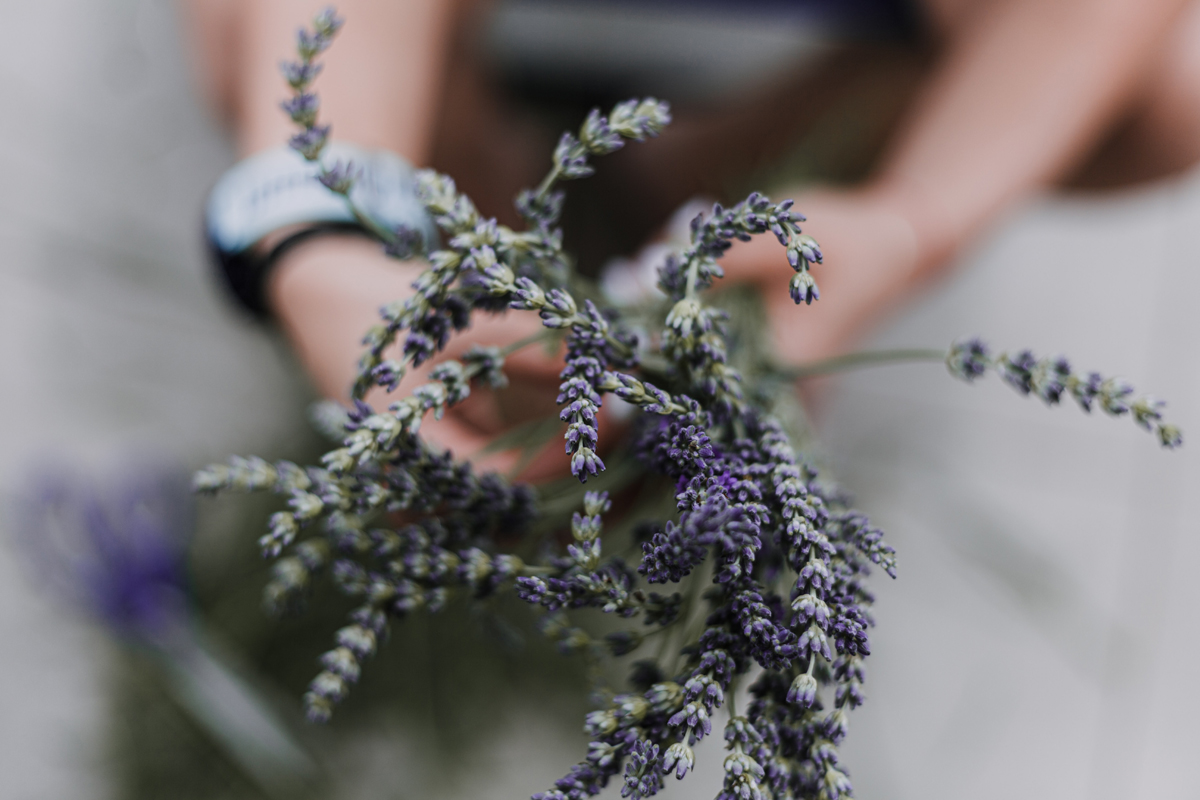
Middle or Heart Notes form the body of the perfume. They bind the blend together and emerge as the top note fades. Common examples include Lavender, Rose, Jasmine, Ylang-Ylang, and Rosemary. They typically make up about 50 percent of your blend.
Base Notes act as the anchor. These are heavy, slow-evaporating molecules that fix the fragrance to the skin. Common examples include Sandalwood, Cedarwood, Vanilla, Patchouli, and Frankincense. They typically make up about 20 percent of your blend.
The Basic Blending Method
To make a simple alcohol-based or oil-based perfume, follow these foundational steps:
First, select your carrier. Choose high-proof, neutral alcohol like perfumer’s alcohol or vodka for a traditional spray, or a shelf-stable oil like jojoba for a nourishing roll-on perfume.
Second, build from the bottom up. In a clean glass bottle, drip your essential oils starting with your base notes, followed by your middle notes, and finishing with your top notes. Swirl gently after each addition.
Third, combine and cure. Add your carrier liquid to the oil blend. Secure the cap and store the bottle in a cool, dark place. Let it cure for at least two to four weeks. This allows the distinct botanical elements to marry and form a cohesive scent profile.
Four Seasonal Formula Inspirations
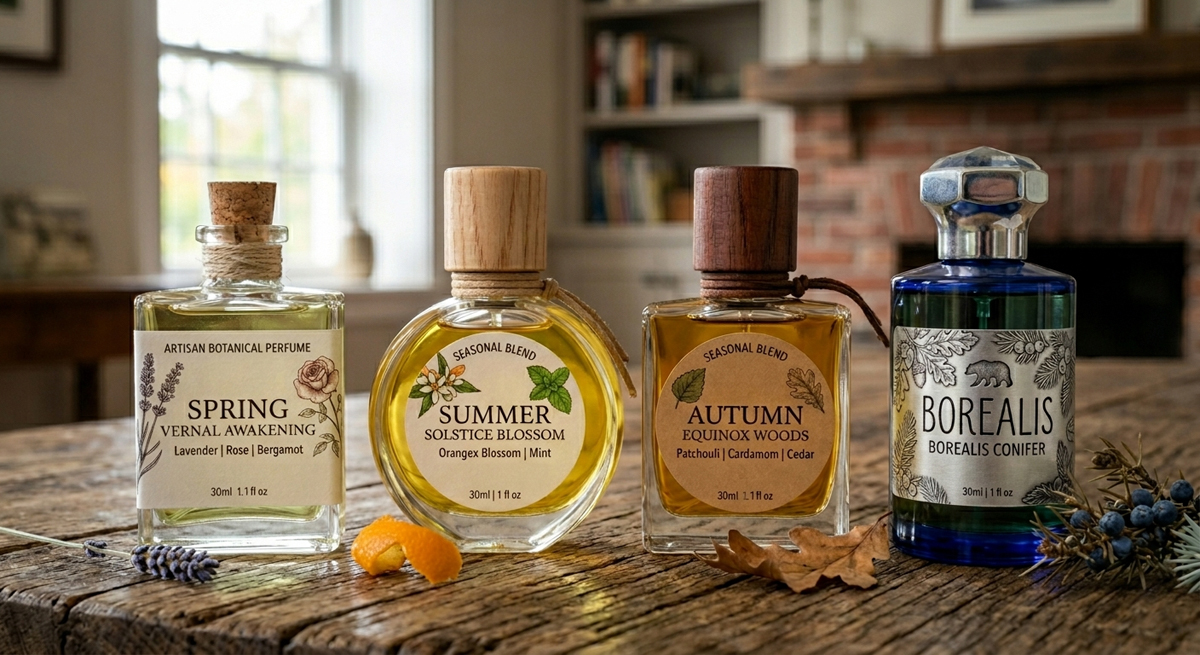
For a Spring Vernal Awakening blend, combine 3 drops of Cedarwood as your base, 10 drops of Lavender and 5 drops of Rose absolute for your heart, and 7 drops of Bergamot for your top note. This creates a fresh, romantic stroll through a budding garden.
For a Summer Solstice Citrus blend, combine 4 drops of Vanilla infusion as your base, 8 drops of Neroli and 4 drops of Rosemary for your heart, and 9 drops of Pink Grapefruit for your top note. This results in a bright, energetic, and cleanly effervescent scent.
For an Autumn Equinox Woods blend, combine 5 drops of Patchouli and 2 drops of Vetiver as your base, 10 drops of Cardamom for your heart, and 8 drops of Sweet Orange for your top note. This offers an earthy, spicy, and deeply grounding profile.
For a Winter Fireside Balsam blend, combine 6 drops of Frankincense and 2 drops of Myrrh as your base, 8 drops of Pine or Fir Needle for your heart, and 6 drops of Mandarin for your top note. This brings forward a resinous, rich scent reminiscent of cozy winter nights.
Tips for Storing and Using Seasonal Perfumes
Preserving the Integrity of Your Blends
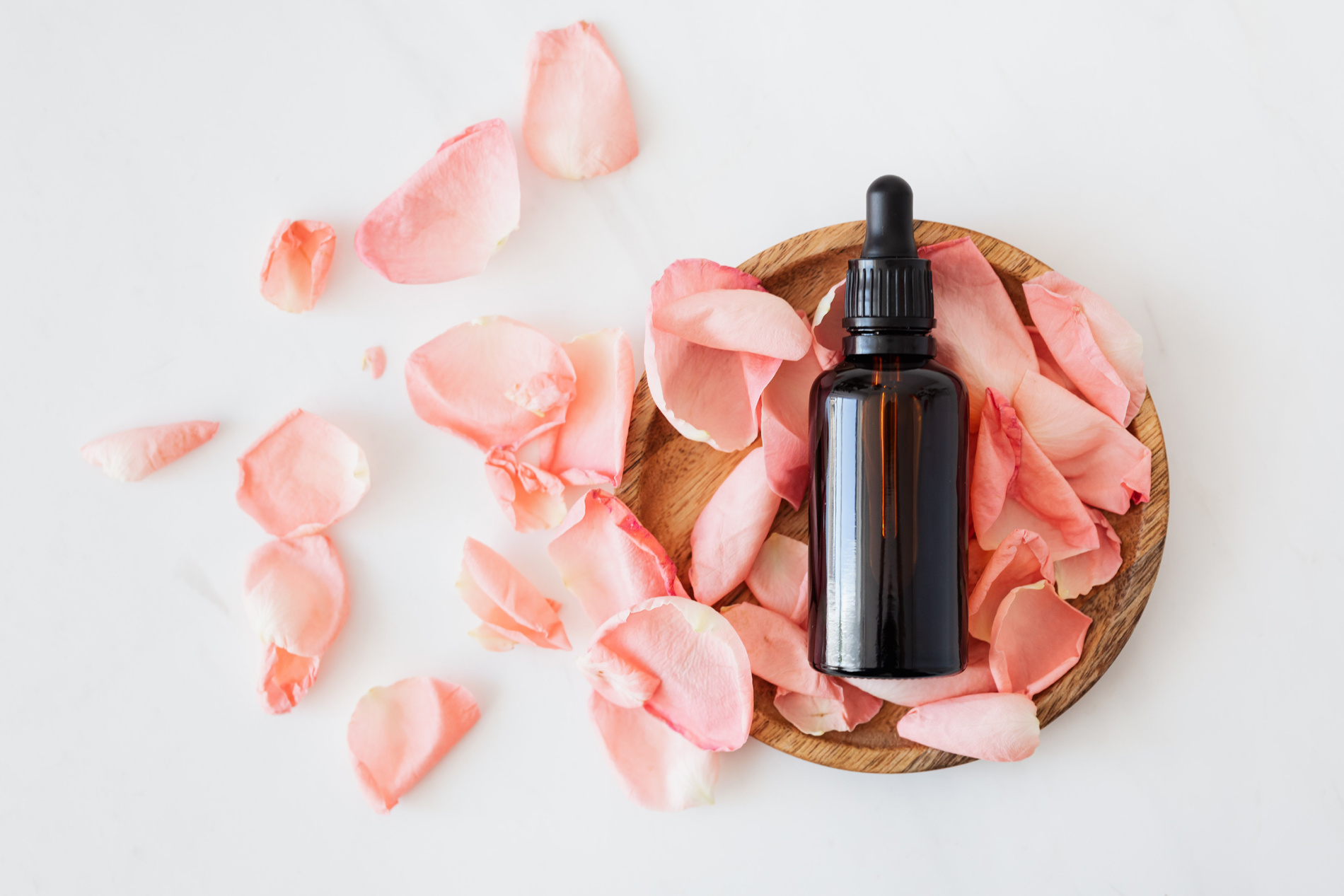
Natural perfumes do not contain synthetic preservatives or UV stabilizers. To prevent light and heat from breaking down the delicate botanical molecules, which can cause your perfume to turn sour or lose its scent, always store your creations in dark amber or cobalt glass bottles. Keep them away from bathroom humidity and direct sunlight. A cool bedroom drawer or closet shelf is ideal.
Application for Longevity
Because natural perfumes lack synthetic fixatives, they generally wear closer to the body and fade faster than commercial versions, usually lasting about 2 to 5 hours. To maximize their lifespan, apply them directly to pulse points. The wrists, inside the elbows, and the base of the neck generate body heat, which slowly coaxes the fragrance notes forward.
It also helps to moisturize your skin first. Essential oils evaporate quickly on dry skin, so applying an unscented lotion or jojoba oil to your pulse points before spraying your perfume gives the fragrance molecules something to anchor to. Finally, avoid rubbing your wrists together after application. Friction creates sudden heat that prematurely shears away the delicate top notes, altering the intended evolution of the scent.
Drawing Inspiration from the Archives
If you have experimented with any of our foundational blending techniques in previous recipes, like our classic apothecary roll-ons or solid botanical salves, you already have the skills needed to master seasonal blending.
Take a look at those earlier formulas as your canvas. You can easily adapt a favorite year-round recipe by swapping out a single element to match the current season. For instance, if you love a classic Vanilla-Lavender everyday blend, try swapping the bright Lavender for warm, spicy Cardamom when the autumn leaves begin to turn. The beauty of natural perfumery is that there are no rigid rules, only guidelines to spark your creativity. Trust your nose, experiment with small test batches, and let the seasons guide your hand!
Pioneerthinking.com: Ingredients for a Simple Life. Insights from a seasoned professional rooted in country living, with 28 years of horticulture expertise and over two decades of practical experience in homesteading, natural beauty and cosmetic creations, natural health, cooking and creative living.
Photo. Gemini