Quick Brown Sauce & White Sauce Recipes
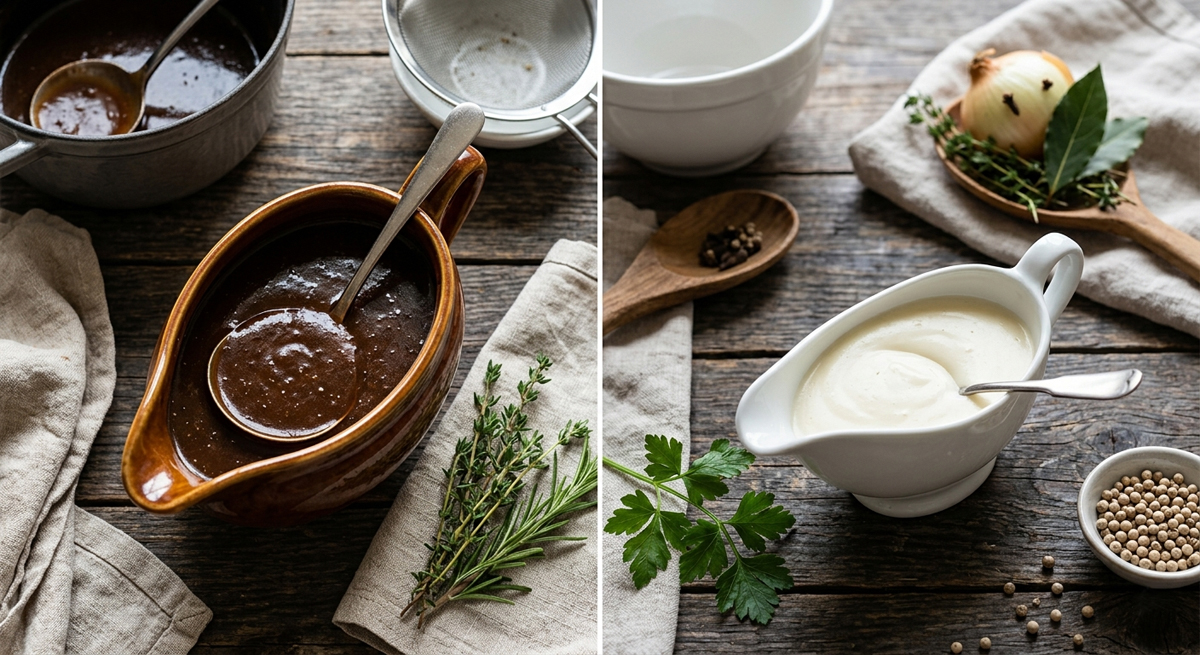
In the world of classical French cuisine, the “Mother Sauces” serve as the DNA for nearly every dish that leaves the pass. Mastering these foundations—specifically the deep, savory Espagnole (Brown Sauce) and the silky, versatile Béchamel (White Sauce)—is what separates a home cook from a true saucier. While one relies on the patience of roasting bones and long simmering to achieve a rich complexity, the other depends on the delicate balance of a pale roux and infused milk. Together, they provide an infinite map of culinary possibilities, allowing you to pivot from a rustic beef stew to a sophisticated Mornay with confidence.
Quick Brown Sauce & White Sauce Recipes
Traditional Brown Sauce
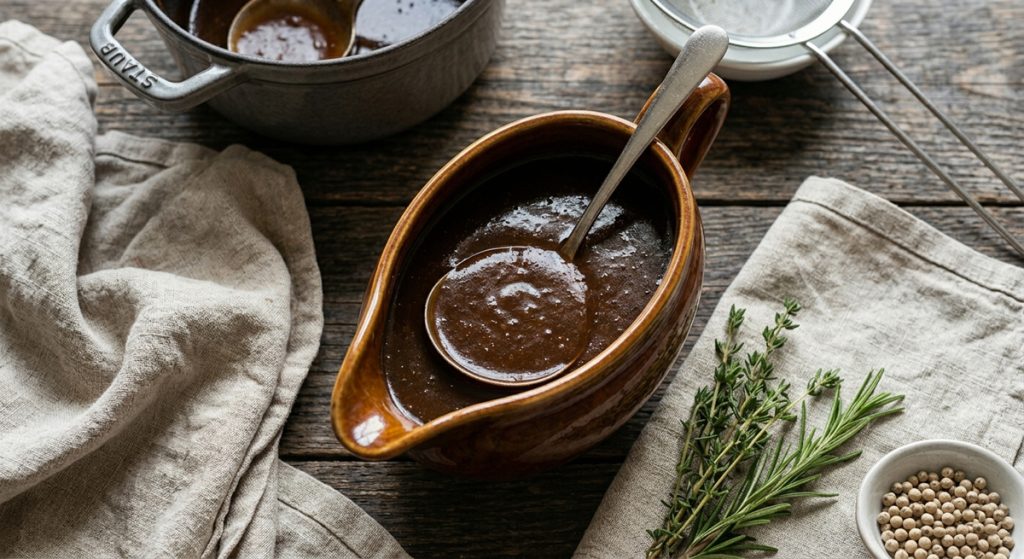
Yields approximately 3-4 pints
Ingredients
- 2 lbs Beef bones (knuckle or marrow bones work best)
- 3 oz Beef dripping or lard
- 1 oz Bacon, finely diced
- 4 oz Carrots, diced
- 4 oz Yellow onions, diced
- 2 oz Mushroom trimmings
- 3 oz All-purpose flour
- 1/2 oz Tomato puree
- 4 pints Brown stock
- Salt and black pepper to taste
The Method
- Roast the Bones: Preheat your oven to 170°C (325°F). Place the beef bones in a roasting tin with a small amount of fat. Roast for 1 to 2 hours, turning occasionally, until they are deeply browned and fragrant. This step is vital for the color and “roasted” profile of the final sauce.
- Sauté the Aromatics: While the bones are roasting, melt the dripping in a heavy-bottomed pot over medium heat. Add the diced bacon, carrots, onions, and mushroom trimmings. Sauté gently until the vegetables have softened and taken on a light golden-brown color.
- Build the Roux: Stir the flour into the vegetable and bacon mixture. Continue to cook over medium-low heat, stirring frequently. You are looking for a Brown Roux—the flour should smell nutty and turn a rich, toasted cinnamon color. Once achieved, stir in the tomato puree and cook for another minute.
- Simmer and Deglaze: Slowly whisk in the brown stock, ensuring there are no lumps. Bring the mixture to a gentle boil. Carefully transfer the browned bones from the oven into the pot.
Pro Tip: Don’t leave the flavor behind! Pour off the excess fat from the roasting tin, then add a splash of stock or water to the tin to scrape up all the caramelized bits (the fond). Add these sediments to your pot.
- The Long Simmer: Reduce the heat and let the sauce simmer for 1.5 to 2 hours. Skim any foam or fat that rises to the surface. Once the sauce has thickened and the flavors have married, season with salt and pepper.
- Finishing: Strain the sauce through a fine-mesh sieve or cheesecloth into a clean bowl, discarding the solids. Your sauce is now ready to be used as a base or flavored with herbs, wine, or peppercorns.
Quick Variations
- Bordelaise: Add a reduction of red wine, shallots, and thyme.
- Mushroom: Sauté sliced mushrooms in butter and stir into the finished sauce.
- Lyonnaise: Stir in caramelized onions and a splash of white wine vinegar.
Classic Béchamel (White Sauce)
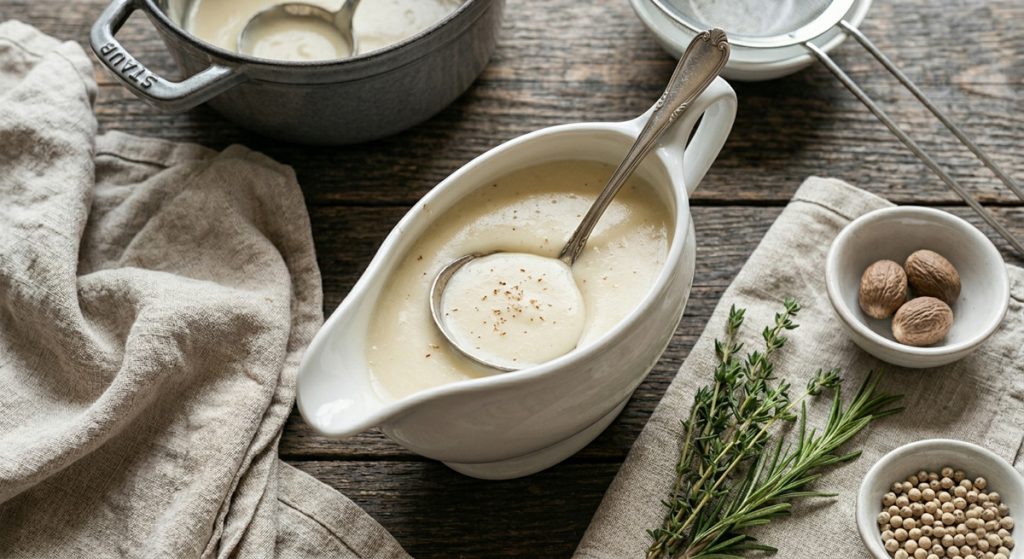
Yields approximately 4 cups
Ingredients
- 4 cups Whole milk
- 1 Small yellow onion
- 3 Whole cloves
- 1 Bay leaf
- 1 Small bunch of fresh herbs (parsley stalks and thyme, tied with kitchen twine)
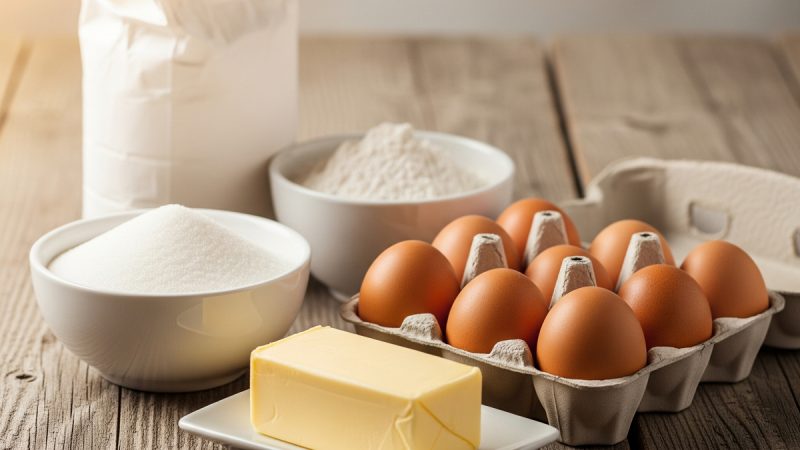
- 6 tbsp Unsalted butter
- ¾ cup All-purpose flour
- To taste: Salt and white pepper
Directions
- Infuse the Milk: Cut the onion in half and press the cloves into the onion skin (this makes them easy to find later). Place the milk, onion, bay leaf, and the herb bundle in a medium saucepan. Bring to a gentle simmer over medium heat, then turn the heat to low and let it steep for 10 minutes.
- Make the Roux: In a separate large saucepan, melt the butter over medium-low heat. Whisk in the flour to create a paste (this is your roux). Cook for 2–3 minutes, whisking constantly. You want the flour to lose its “raw” taste, but do not let it brown; it should remain pale.
- Combine: Slowly pour the warm milk through a strainer into your roux, discarding the onion and herbs. Whisk vigorously to ensure there are no lumps.
- Simmer and Thicken: Bring the sauce to a very slow boil, then reduce the heat to low. Simmer for 10–15 minutes, stirring frequently to prevent the bottom from scorching. The sauce is ready when it is thick enough to coat the back of a spoon.
- Season and Finish: Season with salt and pepper (white pepper is preferred to keep the sauce pristine). Strain one final time through a fine-mesh sieve if you want a perfectly silky texture.
Notes on Conversions
- 3 oz Butter/Flour: In weight, this is roughly 6 tablespoons of butter and ¾ cup of flour.
- 2 Pints: This equals 4 cups (or 1 quart).
The Pioneer View: Waste Not, Want Not
From the perspective of a frontier cook, these sauces weren’t just culinary exercises—they were essential methods for stretching resources. In a pioneer kitchen, the “Brown Sauce” was the ultimate way to respect the animal; those knuckle bones and marrow bits weren’t scraps, they were the “essence” of a week’s worth of meals. The dripping and bacon ends provided the necessary fat for survival, and the long simmer over a hearth turned tough, cheap ingredients into a feast.
Similarly, a White Sauce was often the “great equalizer.” When meat was scarce, a rich Béchamel made with fresh milk from the family cow could turn a handful of garden vegetables or foraged greens into a filling, comforting supper. To the pioneer, a master sauce wasn’t about French prestige; it was about the magic of turning simple flour, fat, and fire into sustenance that tasted like home.
The Author:
Pioneerthinking.com: Ingredients for a Simple Life. Insights from a seasoned professional rooted in country living, with 28 years of horticulture expertise and over two decades of practical experience in homesteading, natural beauty and cosmetic creations, natural health, cooking and creative living.
Photo. Gemini